- Political Culture: The attitudes, beliefs, and values which underpin the operation of a particular political system.
- Political Ideology: Someone's views about government policy.
- Equality Of Opportunity: Political ideal that is opposed to caste hierarchy.
- Equality of Results: Makes sure that everyone turns out the same in the end.
- Civic Duty: The responsibilities of a citizen
- Progressive Culture: Reform movement.
- Orthodox Culture: A culture that sticks to its original beliefs.
- Political Efficacy: theoretical concept used to explain political behavior in Political Science.
- Middle America: average middle-class Americans as a group, as distinguished from the rich or poor or the politically extreme.
- Silent Majority: any group of people who are not outspoken and who are considered to constitute a majority.
- Social Status: position in a social hierarchy.
- Christian Coalition: a US Christian advocacy group, which includes Christian fundamentalists, neo-evangelicals and conservative charismatics.
- Gender Gap: The differences between men and women reflected in politics.
- Liberal: Favorable to progress or reform, as in political or religious affairs.
- Conservative: Cautiously moderate or purposefully low.
- Libertarian: A person who maintains the doctrine of free will.
- Populist: A member of the People's party.
- Political Elite: Any society where power is not distributed equally.
- New Class: Describes the privileged ruling class of bureaucrats and Communist Party functionaries.
- New Deal Coalition: The alignment of interest groups and voting blocs that supported the New Deal and voted for Democratic presidential candidates.
- Random Sample: A method of selecting a sample (random sample) from a statistical population.
- Sampling Error: A statistical error to which an analyst exposes a model simply because he or she is working with sample data rather than population or census data.
- Weighting: to burden with or as if with weight.
- Quota Sample: Convenience sample with an effort made to insure a certain distribution of demographic variables.
- Focus Groups: A representative group of people questioned together about their opinions on political issues.
- Instant Response Polling: Polls done in the days following a debate or other political event to get immediate public opinions.
- Push Polls: Seemingly unbiased telephone survey that is actually conducted by supporters of a particular candidate and disseminates negative information about an opponent.
- Bandwagon Effect: The phenomenon of a popular trend attracting even greater popularity.
- Refusal Rate: In the sampling of human populations, the proportion of individuals who, though successfully contacted, refuse to give the information sought.
- Exit Polls: A poll taken of a small percentage of voters as they leave the polls.
- Tracking Poll: A type of poll repeated periodically with the same group of people to check and measure changes of opinion or knowledge.
- Skewed Question: Phrased in such a way that a certain answer is more likely to be given.
- Context Effect: The aspect of cognitive psychology that describes the influence of environmental factors on one's perception of a stimulus.
- Saliency: A projection of the forward line into enemy-held territory.
- Help America Vote Act 2002: Passed by Congress in October 2002 to making sweeping reforms to the nation's voting process.
- Motor-Voter Law 1993: Law that enables prospective voters to register when they obtain or renew a driver's license.
- 15th Amendment: Prohibiting the restriction of voting rights “on account of race, color, or previous condition of servitude.”
- Literacy Test: An examination to determine whether a person meets the literacy requirements for voting
- Poll Tax: A tax levied per head of adult population.
- Grandfather Clause:A clause in the constitutions of several Southern states that waived electoral literacy requirements for lineal descendants of people voting before 1867, thus ensuring the franchise for illiterate White people: declared unconstitutional in 1915
- White Primary: In 1920 Southern states used the white primary as a way of limiting African Americans playing a part in the politics.
- Voting Rights Act: Eliminated literacy tests and stated that federal examiners could enroll voters who had been denied suffrage by local officials.
- 19th Amendment: An amendment to the U.S. constitution, ratified in 1920, guaranteeing women the right to vote.
- 26th Amendment: An amendment to the U.S. constitution, ratified in 1971, lowering the voting age to 18.
- 23 Amendment: An amendment to the U.S. constitution, ratified in 1961, allowing District of Columbia residents to vote in presidential elections.
- Disfranchisement: To deprive a person of the right to vote or other rights of citizenship.
- Australian Ballot: A ballot containing the names of all the candidates for public office, handed to the voter at the polling station to be marked in secret.
- Activist: Advocating or opposing a cause or issue vigorously, especially a political cause.
- Demographics: The statistical data of a population, especially those showing average age, income, education, etc.
Thursday, April 28, 2011
Reading Review

Wednesday, March 16, 2011
The BIGGEST budget cuts!
Community Health Centers:
Serve 20million people at 7,000 different locations
- Fundings slashed by $600million for the rest of 2011
- Democrat said: they'll actually see $400million increase in funding
- Each year 4,000 people are maimed or killed by exploading mines
- Stopped making land mimes in the 1990's
- Exports cluster bombs
- U.S. is the largest donor to remove land mines
- Donates $80million -$100million a year for the cause
- Budget cuts $14million a yr from the departments trying to remove the mines
- Lawmakers cut fundings to food for pregant women, infants, and children
 Theyre cutting over $500million
- Served 9.1 million people in 2009
- 2010 budget of $7.3 billion

Heat for Poor People:
- Cut fundings by $390million
- Assisted people with low incomes
- Budget is pose to go towards raising oil prices
- Lawmakers cut $50 million
- Budget is now dropping by $650million
- Funding was $70million over what Obama requested
- Program says to be a:
catalyst for empowering others to prevent, manage and resolve international conflict without resorting to violence,
- Republicans want it eliminated
- Democrats fought for it for the Department of Defense
- $10million of the agency's budget of $50million was elimanated

I think that these budget cuts are really HURTING America! People already have so many responsibilities now they have to also worry but all these budget cuts. The community health centers should not have any cuts health is very imporant in a society. Land mines are very important to be removed people should not have to worry about walking somewhere and stepping on 1. Heat for poor people is not as severe that cut does affect the community but not as badd. Food stamps also are not that bad it will not make a big difference neither will housing assistance for Native Americans. U.S. Institute of Peace is very important not only does it help protect the citizens in the U.S. but also helps prevent and/or supply for wars.
Tuesday, March 15, 2011
Congress Passes Budget Deal
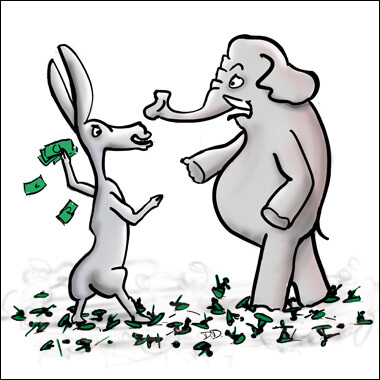 A budget deal averting government shut down just recently won approval by both the House and Senate, now they're just waiting for Obama's approval. The measure cuts $38.5 billion in spending while funding the government for the rest of the current fiscal year. The White House and Congress are now debating over how high to raise the federal debt limit. The measure passed the Republican-controlled House on a 260-167 vote. The bill would not have passed without support from members of both parties, as 59 members of the Republican majority opposed it. The Republicans and Democrats are constatntly debating and disagreeing over the budgets being raised. Obama said: "America faces a choice between a budget-slashing Republican vision that will change how society functions and a revenue-raising Democratic vision that maintains the social safety net in place for decades." Both sides did agree on seeking deficit cuts of $4 trillion over the next 10-12 years.
 Republican Side:
- Passed on a 260-167 vote
- 59 members opposed it
- There vision will change how society functions
- 81 members supported it
- Revenue raisers
- There vision maintains the social safety net
Relation: Republicans vs. Democrats
I strongly support the Democrat side on this situation. Instead of making big changes they want to keep the budget measure the same which makes more since because thats what people is use to. The social safety net vision has been used for decades so the government knows that that option works and its risky. The Republicans think there should be a change but theyre idea will change how society functions, its risky to try something new with such a large amoinut of money that once is gone you can not get back. I think the government should rule with the Democrats on this imoportant decision. The decision between the Democrats and Republicans can also be looked at as a public opinion.
Wednesday, February 9, 2011
Catholics Confess

Technicians have recently came out with a new app! The app is called "Confession: A Roman Catholic App" while some people may think its a joke, others think its a really great idea to have this app with them on their phones and ipods. This app helps people that can no longer get to church almost have church with them in the palm of their hand. This app is only $1.99, but the creators of this app don't want people to think that this app is taking place of the real confessional. They designed it to complement the act of confession, offering a "personal examination of conscience" and a step-by-step guide to sin-confessing. If Catholics use this app, they can engage in their faith through digital technology. Some people see it as a digital Catholic community for their use of prayer and confession. Certain Catholics from Catholic organizations have commented on the app saying that this is a very handy app and that it does help when your on the go or cant get to a confessional.

Relation:
This app can be considered a public opinion, some Catholics may think that its nice to have this confessional on their electronic devices, but is it really that good of an idea? Some will support this app and agree that yes, it is a good idea but what if others are offended. Some Catholics may look at this app as if people are using technology to make a joke out of their religion. If you really believe in your religion and proudly support it you wont download this app but instead just attend the real confessional to relieve your sins, really attending the church will show more dedication and commitment to your fellow Catholics and to yourself for confessing your sins.
Thursday, February 3, 2011
Egypt and their Prime Minister
Egypt's Prime Minster had violently attacked protesters yesterday. The country's president had asked for the security chaos to be investigated. The military was there and witnessed the clashes that were taking place in in the area of Tahrir Square. The violent clash took place between supporters and foes of President Hosni Mubarak, the military didn't want things to get to severe so they decided to step in and divide the two groups. Rocks flew back and forth in an empty construction area in front of a metal barricade that anti-Mubarak protesters set up overnight. Egypt's health minister said on state-run Nile TV that at least five people were killed and 836 injured; including 200 within one hour on Thursday morning.
When an accident occurs like this one you wonder:
- How safe is the place you call home
- Is it safe to protest for what you believe in
- How safe is your President when people protest against him
- Will protesting always lead to deaths
- Who protects you when even the Prime Minister leads to violence
 The crisis has paralyzed the Egyptian economy, forcing the closure of banks, train services and schools. Markets are running short of basic food staples. All because of a protest things have been shutdown and transportation and education will now be lost. The question is how long will it take for the Egyptian economy to recover.
Relation:
Should the Prime Minister or the President be more responsible for the actions that took place that day because all though the Prime Minister created violence it is still the President's country!
Monday, January 31, 2011
State of the Union
This year Obama spoke at the State of the Union. Normally the Democrats and Republicans sit split up into two different shootings, but this year was different. Several people were still devastated about the shooting at Tuscon that just recently happened. To show respect the Democrats and Republicans sat together and looked well united as one. Usually there cheering or yelling or agreeing and disagreeing with the topics being discussed. Obama made sure that he reached out to a very large audience that night. Several things were discussed, some of the most important topics were:
 Schools:
 At the meeting that night Obama also mentioned how he would like for Congress o work together and how transportation should be switched from fossil fuels.
 Schools:
- He feels as if the schools should be meeting higher standards
- More teachers should be hired
- No Child Left Behind
- Troops should be leaving Afghanistan in July
- Iraq
Taxes:
- Freeze health care accounts
- Tax codes
- Simpler & easier
- How do you measure recovery
- Domestic spending
- Common sense
 At the meeting that night Obama also mentioned how he would like for Congress o work together and how transportation should be switched from fossil fuels.
Gridlock
The main question being asked today is, Does Gridlock Matter? Gridlock is the inability of the government to act because rival parties control different parts of the government. The Constitution ensures that the President and Congress will be rivals for power and thus rivals in policy making. This would be and example of what the checks and balances is all about.
Divided Governments:
If you think the president "Will lead the country":
*Typical Presidential Election:
* I think policy gridlock is bad because the government has little to no control over how the government is working due to the rival parties controlling all of the different parts.
Divided Governments:
- When you have a divided government its not easy to tell weather they produce fewer or worse policies than unified ones.
- Divided governments pass important laws, conduct important investigations, and ratify significant treaties.
The 1946 Marshall Plan - Rebuilt war- Torn Europe
- The 1986 Tax Reform Act


If you think the president "Will lead the country":
- Change the Constitution to resemble Parliamentary
- Vote into office members of Congress who agree with the President on policy issues.
*Typical Presidential Election:
- 1/4 of all voters will vote for one party's candidate for president
- Other party's candidate is Congress.
* I think policy gridlock is bad because the government has little to no control over how the government is working due to the rival parties controlling all of the different parts.
Subscribe to:
Posts (Atom)